
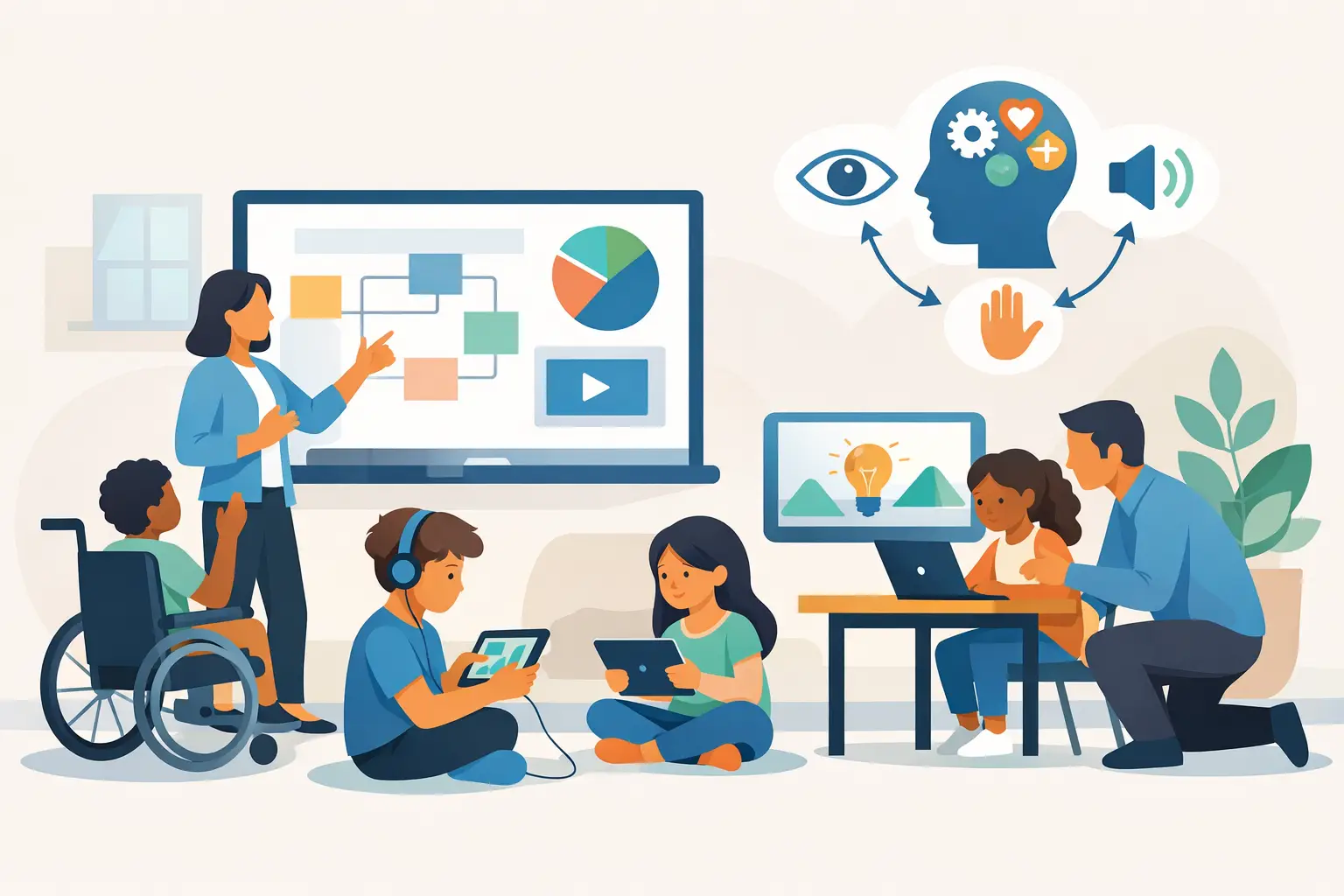
A student who understands a lesson may still struggle to show that understanding in a timed written response. Another may be ready to contribute but disengage when the task feels disconnected from their interests or experiences. In a universal design for learning classroom, these moments are not treated as evidence that a learner does not belong. They are signals to adjust the learning environment so more students can access, engage with, and demonstrate progress toward a shared goal.
Universal Design for Learning, commonly called UDL, is not a separate program for a small group of students. It is a proactive approach to lesson design that anticipates learner variability from the beginning. For educators supporting neurodivergent learners, students with disabilities, multilingual learners, students experiencing trauma, and students with diverse strengths, UDL offers a practical framework for building access without lowering expectations.
What a Universal Design for Learning Classroom Looks Like
A UDL classroom is organized around clear learning goals and flexible pathways. The goal remains meaningful and appropriately challenging, while the methods, materials, and ways students participate can vary. Instead of waiting until a student falls behind to create an accommodation, the teacher plans options that benefit the wider class.
For example, if the objective is to explain how a character changes across a story, every student is still working toward analysis. Some may access the text through print, audio, or teacher-supported reading. Students might use a graphic organizer, discuss ideas with a partner, annotate key passages, or build a visual timeline before writing. They may demonstrate learning through a paragraph, a recorded explanation, or a structured presentation when the format does not conflict with the intended skill.
This approach protects rigor. It asks educators to distinguish between the learning target and the barriers students may encounter on the way to it. If the target is scientific reasoning, handwriting speed should not become the unintended measure of success. If the target is oral communication, a student may need preparation time, visual prompts, or a smaller audience to participate meaningfully.
The Three Areas of UDL
UDL is often described through three connected areas: engagement, representation, and action and expression. These areas help teachers look beyond a single instructional method and consider the full learner experience.
Engagement addresses the reasons students participate and persist. A classroom can support engagement by offering relevant examples, predictable routines, manageable choices, collaboration options, and clear feedback. Choice is helpful when it is purposeful. Too many open-ended options can overwhelm students who need structure, so provide a small number of well-defined choices.
Representation addresses how information is presented. Teachers can pair spoken instruction with visuals, model a process step by step, preteach essential vocabulary, provide captions or transcripts, and use concrete examples before introducing abstract concepts. Multiple formats are especially valuable when a student’s language processing, attention, sensory needs, or prior knowledge affects access to a lesson.
Action and expression address how students practice skills and show learning. Some students may benefit from speech-to-text, sentence frames, manipulatives, assistive technology, checklists, visual planning tools, or opportunities to respond orally. The most appropriate option depends on the objective. Flexibility should remove irrelevant barriers, not remove the skill a student is working to develop.
Start With the Goal, Not the Activity
A common planning habit is to begin with an engaging activity and then decide what students should learn from it. UDL planning works best in the opposite direction. Start by naming the essential knowledge or skill students should gain, then identify what could interfere with access.
Ask: What must students understand or be able to do by the end of this lesson? Which parts of the task are essential, and which parts are simply one traditional way of completing it? What background knowledge, language, executive functioning, sensory, motor, or social demands may create barriers?
Consider a middle school math lesson on solving multi-step equations. The goal is not copying a lengthy problem from the board or remembering every direction after hearing it once. To support access, the teacher might provide worked examples, color-code inverse operations, chunk problems into stages, and offer a checklist for self-monitoring. Students could work independently, with a peer, or during a brief teacher-guided small group. These supports help students direct their energy toward mathematical reasoning.
Clarity matters just as much as flexibility. Post the learning goal in student-friendly language, explain what quality work looks like, and revisit the goal during the lesson. Students are more likely to persist when they know where they are going and how they can tell they are making progress.
Build Choice Without Creating Confusion
Meaningful choice can strengthen autonomy and motivation, but it needs boundaries. Students do not need unlimited options in every lesson. They need reliable opportunities to make decisions that support their learning.
A teacher might allow students to choose whether to read independently or listen to an audio version, complete a written response or record an explanation, or use a digital or paper planning tool. For group work, students may choose among defined roles that match their strengths while still practicing collaboration. A student who finds public speaking stressful might begin as the group’s evidence finder or visual designer, then gradually take on a speaking role with support.
Choice should never become a quiet way of excluding students from challenging work. If a learner consistently selects the least demanding option, consider whether the available supports are adequate, whether expectations are clear, or whether the student needs scaffolded practice to build confidence. UDL is responsive teaching, not a collection of permanent escape routes.
Make Supports Normal, Visible, and Available
When tools are available to everyone, students are less likely to feel singled out for using them. A classroom calm corner, visual schedule, word bank, noise-reducing headphones, timer, assignment checklist, or speech-to-text tool can be framed as a learning resource rather than a marker of difficulty.
This does not mean every support is universally appropriate. Some accommodations must remain individualized and documented through a student’s IEP, 504 Plan, or support plan. UDL and individualized accommodations work together. UDL reduces common barriers for many learners, while individualized planning addresses needs that require specific, personalized support.
Educators should also watch for unintended barriers in classroom culture. A student may have access to a graphic organizer but avoid using it because peers see it as remedial. Normalize strategic help-seeking by modeling your own use of tools: “I am using this checklist so I can keep track of the steps.” Celebrate effort, revision, and problem-solving alongside correct answers.
Use Assessment to Expand Participation
Assessment is where a well-designed lesson can lose its flexibility. If students have had multiple ways to learn and practice, a single narrow assessment may not accurately reflect what they know. Whenever possible, offer appropriate options for students to demonstrate understanding while using common criteria tied to the learning goal.
A social studies teacher assessing an argument might accept a written claim, an oral recording, or a visual presentation with an explanation. The rubric can still measure evidence, reasoning, and clarity. If writing mechanics are also part of the objective, assess them transparently rather than allowing them to overshadow content knowledge without notice.
Frequent low-stakes checks are equally valuable. Exit tickets, quick conferences, response cards, digital polls, and student self-ratings provide information before misunderstandings become entrenched. They also give quieter students and students with processing differences more than one avenue for participation.
Collaborate Around the Learner
A universal design for learning classroom becomes stronger when educators do not plan in isolation. Special educators, classroom teachers, related service providers, school counselors, paraprofessionals, and families each see different parts of a student’s experience. Their perspectives can reveal patterns that a single observation may miss.
Collaboration works best when it focuses on strengths and observable needs. Rather than saying a student is unmotivated, a team might notice that the student participates actively in hands-on tasks, struggles when directions are delivered only verbally, and completes more work when assignments are broken into shorter segments. This leads to actionable planning.
Professional learning can help teams move from good intentions to consistent practice. The Sen Institute supports educators in translating inclusive, research-based principles into practical strategies that strengthen access, advocacy, and confidence across school settings.
Begin With One Lesson
UDL does not require redesigning every unit overnight. Start with one recurring barrier in one lesson. Add a visual model to a verbal explanation, offer two ways to practice a skill, or create a clear checklist for an independent task. Observe who benefits, ask students what helped, and refine the next lesson.
The aim is not to make learning easier. It is to make participation more possible, expectations more transparent, and progress more visible. Each thoughtful adjustment communicates a powerful message to students: your differences are anticipated here, your strengths matter, and you have a place in this learning community.



1 Comment
[…] may need language for repair. A student who tears up work after an error may need support with flexible thinking and a structured way to restart. A learner who frequently calls out may need a more accessible […]