
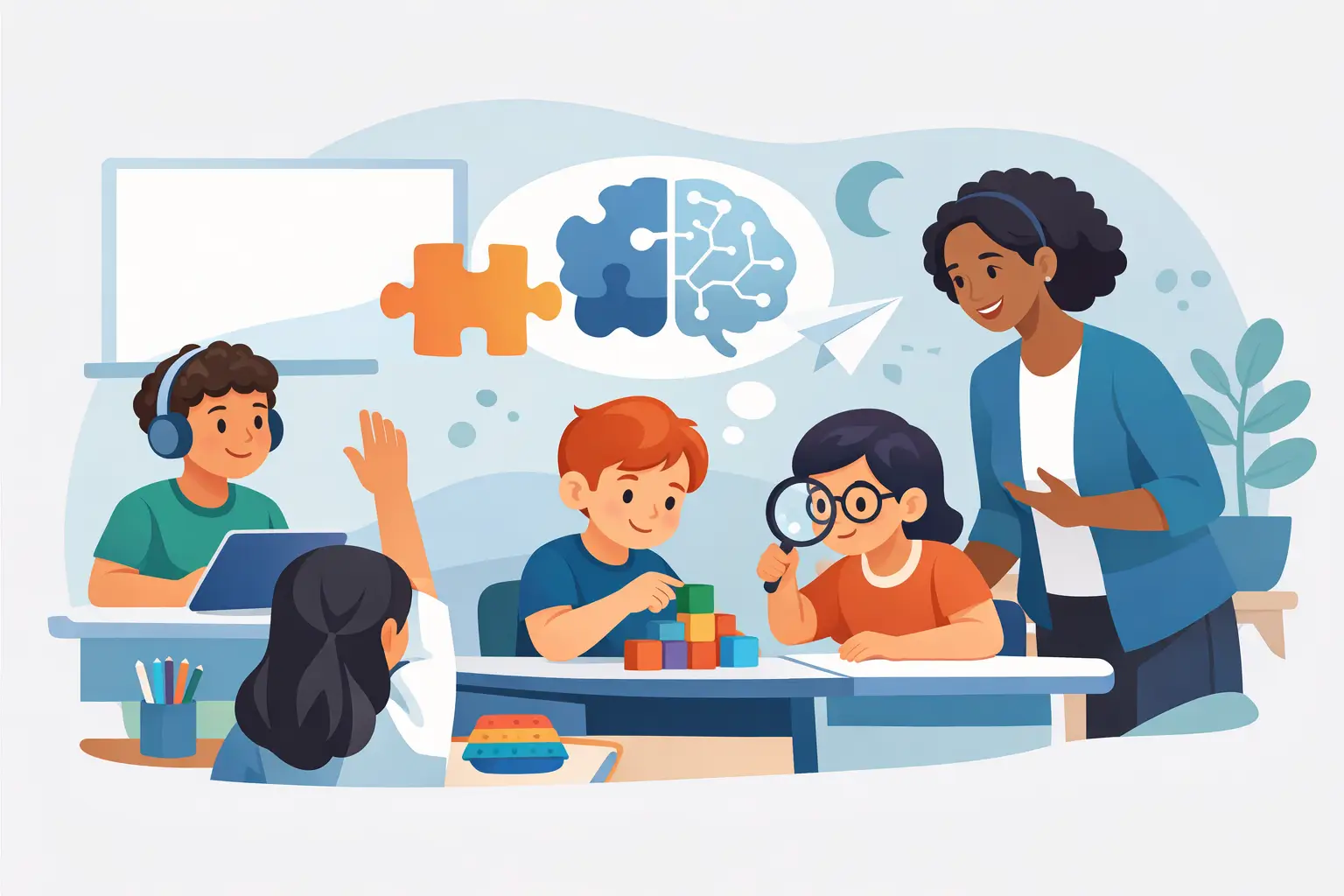
A student who looks away while listening, rocks during a read-aloud, asks to type rather than handwrite, or needs extra time to begin is communicating something about how they access learning. Neurodiversity affirming classroom strategies help educators respond with curiosity and practical support instead of treating differences in attention, communication, movement, sensory processing, or organization as problems to eliminate.
This approach does not lower expectations. It removes unnecessary barriers so students can show their knowledge, build skills, and participate with dignity. For teachers and support professionals, the work begins with a useful question: What is this learner telling us about the conditions they need to succeed?
What a Neurodiversity-Affirming Classroom Looks Like
A neurodiversity-affirming classroom recognizes that there is no single “right” way to learn, communicate, regulate, or demonstrate understanding. Neurodivergent students, including autistic students, students with ADHD, dyslexia, dyspraxia, language differences, and other learning profiles, bring individual strengths and support needs. Their needs may also change by task, time of day, sensory environment, and level of stress.
Affirming practice is not the same as offering unlimited choice or avoiding challenge. Students benefit from explicit instruction, meaningful feedback, and high expectations. The difference is that educators offer multiple pathways toward those goals. A student may need a visual model before starting a task, speech-to-text for written expression, movement during instruction, or a quieter place to regulate before rejoining a group.
This distinction matters because compliance can be misleading. A quiet student may be overwhelmed rather than engaged. A student who refuses a worksheet may understand the content but be unable to manage the handwriting, visual clutter, or open-ended directions. When behavior is treated as information, adults can teach skills and adjust environments without compromising student dignity.
Start With Predictability, Then Build Flexibility
Predictable routines reduce the amount of energy students must spend figuring out what happens next. That leaves more capacity for learning, peer connection, and problem-solving. Post a clear agenda, preview changes early when possible, and state the purpose of an activity before asking students to begin.
Visual supports are often helpful, but they should be usable rather than decorative. A simple sequence showing “first, then, next” may be more effective than a crowded wall of posters. For a multi-step assignment, provide a checklist with examples of what finished work can look like. Students who do not need the support can move on independently, while others gain a reliable reference point without being singled out.
Flexibility belongs alongside structure. A schedule should be dependable, but unexpected changes happen. When an assembly replaces a usual lesson or a substitute teacher arrives, name the change, explain what will remain the same, and offer a brief transition plan. This small act can prevent avoidable distress and builds trust over time.
Make Transitions Teachably Clear
Transitions are often difficult because they require several executive-function skills at once: stopping, shifting attention, organizing materials, understanding the next expectation, and managing emotions. Rather than repeating “hurry up,” teach the transition as a routine.
Try giving a two-minute warning, followed by one direct instruction at a time: “Close your notebook. Put your pencil in the tray. Meet your group at table three.” A visual timer, a consistent cue, or a peer model can help. If a student still struggles, consider whether the transition itself needs more support rather than assuming the student is unmotivated.
Design for Sensory and Regulation Needs
Classrooms can be busy, bright, loud, and socially demanding. For some learners, those conditions create fatigue or dysregulation long before adults notice outward signs. Sensory support is not a reward students earn after completing work. It is an access need that can make participation possible.
Offer a range of options without requiring students to disclose personal information. A quieter work area, headphones during independent work when appropriate, flexible seating, access to water, and planned movement opportunities can support many students. The most effective option depends on the learner and the task. Some students focus better with background sound or gentle movement; others need reduced stimulation.
A regulation space should not function as exclusion or punishment. If your classroom has a calm corner, teach all students how and when to use it. Keep it simple, predictable, and time-limited when needed: a comfortable seat, visual breathing prompt, paper and pencil, or a sensory tool. Students should know how to return to learning, and adults should avoid demanding verbal explanations while a student is overwhelmed.
Offer Choice Without Creating More Demands
Choice can strengthen autonomy, but too many options can increase anxiety or decision fatigue. Aim for bounded choices that lead to the same learning objective. For example, students might choose whether to show understanding through a short written response, an audio recording, or a labeled diagram. During independent work, they may choose between two locations or decide which of two tasks to complete first.
The key is to separate the learning goal from the method whenever possible. If the goal is to explain a character’s motivation, handwriting speed should not become the hidden measure of success. If the goal is to solve a math problem, a student may need a worked example, graph paper, manipulatives, or permission to explain their reasoning aloud.
Choice does have trade-offs. A student who is still developing planning skills may need fewer options and more adult guidance. Start small, observe what improves access, and expand independence gradually.
Use Communication That Presumes Competence
Neurodiversity-affirming practice begins with the assumption that students have thoughts, preferences, and abilities that may not be visible through conventional classroom behavior. Speak directly to students, use age-respectful language, and provide time to process questions. Avoid interpreting limited eye contact, delayed responses, or alternative communication as a lack of understanding.
Make directions concrete. Instead of “Write more,” say, “Add one detail that shows where the scene takes place.” Instead of “Be good in group work,” state the observable expectation: “Take turns speaking, ask before using someone’s materials, and choose one role for the first five minutes.” Clear language supports all learners and reduces the need for correction after confusion has already occurred.
For students who use augmentative and alternative communication, gestures, visuals, or reduced speech, participation should not depend on speaking quickly. Build wait time into discussions, provide ways to contribute before the moment arrives, and accept varied forms of response. Communication access is academic access.
Respond to Behavior With Skill-Building, Not Shame
When a student leaves their seat, tears work, argues, shuts down, or appears to ignore a direction, the immediate priority is safety and regulation. Public correction, escalating demands, or consequences that remove access to learning often make the situation worse.
After the student is calm, look for patterns. Was the task unclear? Was the room noisy? Did a social demand become too complex? Was the work too easy, too difficult, or too lengthy? A behavior may serve a function, but it is also shaped by context. The same student may thrive in a hands-on science activity and struggle during a fast-paced, language-heavy worksheet.
Teach an alternative skill that meets the same need. A student who escapes difficult writing may learn to request a break, use a sentence starter, or complete one section at a time. A student who calls out may practice recording an idea on a note card while waiting. This takes consistency, and progress is rarely linear, but it is more respectful and durable than asking students to mask distress.
Plan With Strengths, Families, and Colleagues
Effective support is stronger when it is shared. Families can offer valuable insight into a student’s interests, communication preferences, stress signals, and successful strategies. Begin conversations with strengths and specific observations, not a list of concerns. “I noticed Maya brings remarkable knowledge to our animal research discussions” creates a more collaborative starting point than a deficit-focused report.
Coordinate with special educators, counselors, related service providers, and school leaders so supports are not dependent on one caring adult. Keep documentation practical: what helps, when it helps, and what signs suggest a student needs a different level of support. This is especially valuable during transitions between grades, classes, or school settings.
For educators building greater confidence in this work, professional learning should connect research to the realities of a classroom. The Sen Institute emphasizes practical, inclusive tools that help professionals strengthen advocacy, collaboration, and responsive instruction across diverse learning environments.
Begin With One Meaningful Change
You do not need to redesign every lesson by tomorrow. Choose one recurring barrier in your classroom: unclear transitions, lengthy written directions, limited ways to participate, or a regulation plan that only begins after a crisis. Make one thoughtful adjustment, ask students what helps, and observe the result.
A classroom becomes more inclusive through repeated moments of respect: pausing long enough for a student to process, offering a visual before confusion grows, protecting a learner’s dignity during distress, and noticing competence in forms that may be easy to miss. Those moments tell students that they do not have to become someone else to belong.