
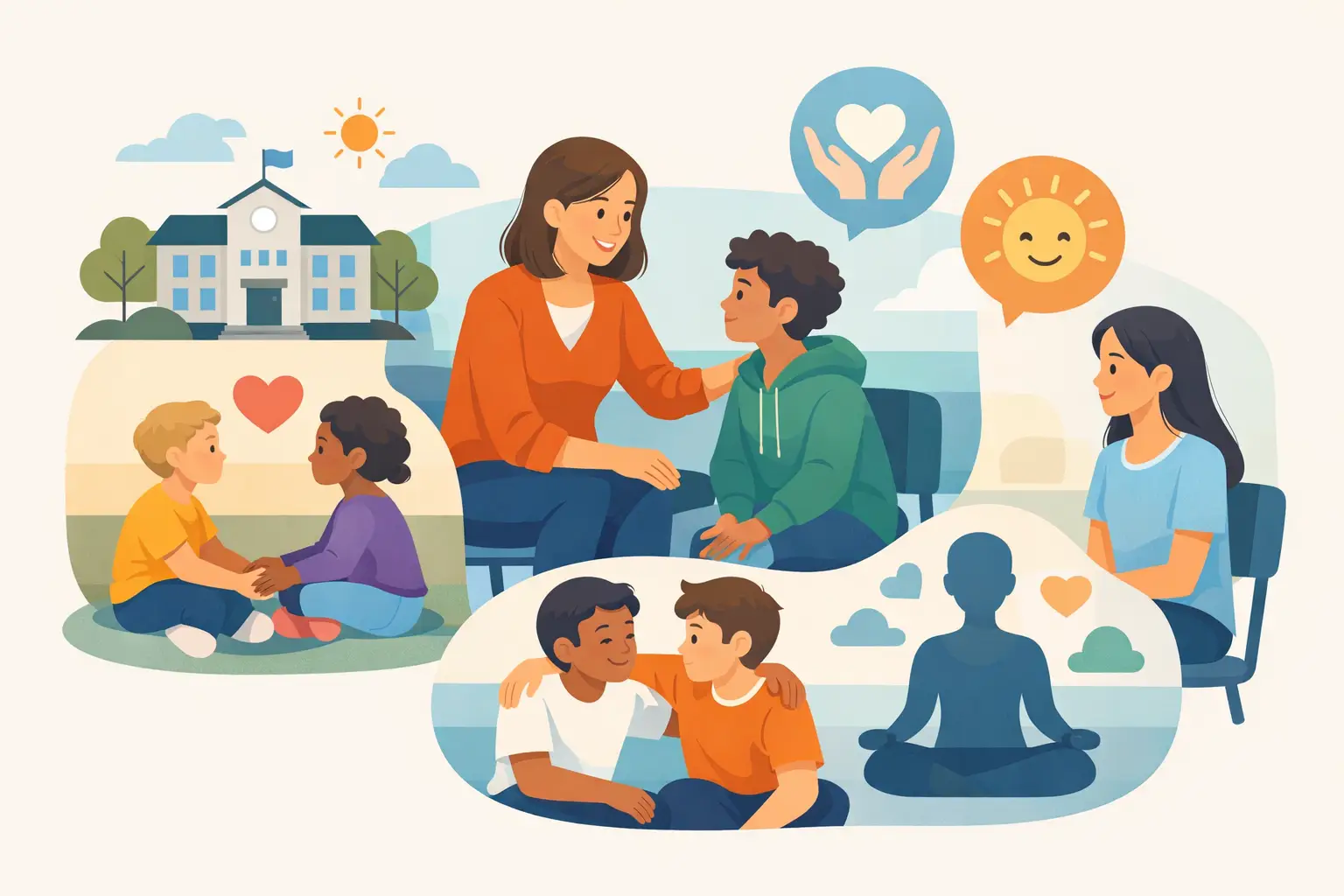
A student who puts their head down during independent work may be tired, overwhelmed, worried about getting an answer wrong, or trying to avoid attention. The same behavior can carry very different meanings. Effective social emotional support in schools begins when educators look beyond compliance and ask a more useful question: What might this learner need in order to participate?
That shift matters for every student, and it is especially meaningful for neurodivergent learners, students with disabilities, children navigating trauma or family stress, and those who have learned that school is not always a safe place to make mistakes. Social-emotional support is not an add-on reserved for counseling offices or crisis moments. It is part of how a school makes learning accessible, relationships dependable, and expectations achievable.
What Social Emotional Support in Schools Looks Like
Social-emotional support helps students recognize emotions, build relationships, manage stress, make decisions, and seek help when they need it. In schools, it also means creating conditions where students can bring their full selves into the classroom without being reduced to a label, behavior, or academic score.
This does not require teachers to become therapists. Educators are not expected to diagnose a student’s emotional needs or carry complex concerns alone. Their role is to notice patterns, build trust, use supportive classroom practices, and connect students and families with the right people when additional support is needed.
For a classroom teacher, this may look like greeting students by name, teaching routines explicitly, offering a quiet way to request a break, and checking in after a difficult moment. For a learning-support professional, it may involve helping a student identify effective regulation strategies and ensuring accommodations are used consistently. For school leaders, it means protecting time for collaboration and making support systems clear rather than leaving staff to improvise.
The strongest approaches combine universal practices for all students with more individualized support for students who need it. A predictable morning routine benefits the whole class. A visual schedule, sensory support, or individualized check-in may be essential for one learner.
Start With Safety, Belonging, and Predictability
Students are more available for learning when they know what to expect and believe that adults will respond with steadiness. Predictability is not rigidity. It is a foundation that gives learners enough security to take academic and social risks.
Clear routines can reduce the hidden demands of the school day. Explain what arriving, transitioning, asking for help, collaborating, and ending a lesson look like. Model the process, practice it, and revisit it after breaks or schedule changes. Students who appear resistant may not understand the expectation, may need more processing time, or may be managing anxiety around an unfamiliar task.
Belonging also grows through small, repeated interactions. A brief welcome at the door, a specific acknowledgment of effort, or a private check-in can communicate, “You are seen here.” These moments are particularly powerful when a student has experienced frequent correction or exclusion.
Language makes a difference. Rather than saying, “You are being disruptive,” an educator might say, “I can see this feels hard right now. Let’s work out what will help you rejoin.” The expectation for participation remains, but the student’s dignity remains intact as well.
Teach Skills Instead of Assuming Students Have Them
Many school expectations are social-emotional skills in disguise. Students are asked to work in groups, recover from feedback, wait for a turn, cope with disappointment, organize materials, and advocate for help. These abilities develop over time, and learners may need direct instruction and repeated opportunities to practice them.
A student who walks away from a peer conflict may need language for repair. A student who tears up work after an error may need support with flexible thinking and a structured way to restart. A learner who frequently calls out may need a more accessible participation routine, such as response cards, planned movement, or a visual reminder of when to contribute.
Teaching these skills works best when it is embedded in ordinary instruction rather than delivered only after a problem occurs. Before group work, teach students how to enter a conversation, disagree respectfully, and ask for clarification. Before an assessment, discuss what anxious feelings can look like and identify a plan for pausing, breathing, or requesting support.
Students should not be expected to use a strategy that has only been mentioned once. Offer modeling, guided practice, visual cues, and low-stakes rehearsal. Then recognize growth specifically: “You noticed you were frustrated, asked for a minute, and came back to the task. That is a strong reset.”
Respond to Behavior With Curiosity and Boundaries
Supportive practice does not mean removing boundaries or ignoring behavior that affects others. Students need clear limits, accountability, and opportunities to repair harm. The difference is that consequences should teach rather than simply punish.
When behavior escalates, immediate safety comes first. Reduce the audience when possible, use calm and brief language, and avoid turning the moment into a public power struggle. After the student has regulated, a restorative conversation can explore what happened, who was affected, and what repair may look like.
The question is not whether students should be held accountable. They should. The question is whether the response builds the capacity to make a different choice next time.
It also depends on the behavior and the student’s needs. A universal response may be appropriate for a minor classroom disruption, while repeated shutdowns, aggression, elopement, or intense distress may call for a coordinated individualized plan. Patterns deserve team-based problem solving, including input from families and, when appropriate, counselors, psychologists, special educators, and administrators.
Make Support Accessible to Neurodiverse Learners
Social-emotional support can unintentionally exclude students when it relies on one “right” way to communicate, regulate, or participate. Eye contact, verbal sharing, sitting still, and quick responses are not reliable measures of engagement or emotional well-being.
Inclusive practice offers students multiple ways to access support. A check-in can happen through a rating scale, a written note, a visual choice board, or a quiet conversation. A regulation break might involve movement, headphones, a calm space, sensory tools, or a purposeful classroom task. The most effective option is the one that helps the learner return to meaningful participation, not the one that looks most conventional.
Avoid treating a student’s coping strategy as defiance simply because it differs from adult expectations. At the same time, support plans should be practical for the classroom. A strategy that requires constant one-to-one adult attention may not be sustainable without additional staffing or adjustments. Teams should identify what can be used independently, what requires adult support, and how progress will be reviewed.
Build a Shared Schoolwide Response
Students can feel the difference between a school where support depends on one caring adult and a school where adults share a common approach. Consistency across classrooms, hallways, lunch periods, and support services reduces confusion and helps students trust the system around them.
A schoolwide approach does not mean every educator uses identical scripts. It means staff share key commitments: behavior is communication, students deserve dignity, expectations are taught, concerns are documented, and families are partners in planning.
Regular collaboration is essential. Teachers may notice classroom triggers. Families can offer insight into strengths, communication preferences, and successful strategies outside school. Specialized staff can help interpret patterns and recommend accommodations or interventions. When these perspectives are combined, support becomes more accurate and less reactive.
Professional learning should also move beyond broad encouragement to practical implementation. Educators benefit from rehearsing de-escalation language, adapting routines, using trauma-informed strategies, and discussing real case scenarios with experienced specialists. Training is most valuable when staff can apply it the next morning and return to refine their approach.
Measure Progress Without Reducing Students to Data
Schools need to know whether their support is making a difference, but meaningful progress is not always captured by one behavior chart or screening score. Look for changes in participation, peer connection, help-seeking, attendance, recovery after setbacks, and the student’s own sense of belonging.
Invite student voice whenever possible. A learner may be able to explain that a quiet check-in helps, that lunch is the hardest part of the day, or that a visual reminder feels less embarrassing than a verbal prompt. These insights can prevent adults from designing support around assumptions.
Documentation should be focused and useful. Record observable patterns, strategies tried, student responses, and next steps. Avoid language that defines a learner by deficits. “Needs a preview before transitions” is more actionable and respectful than “cannot handle change.”
Social-emotional support becomes credible when students experience it as more than a poster on a wall or a lesson taught once a month. It lives in the pause before correction, the routine that lowers anxiety, the team conversation that leads to better support, and the adult who keeps communicating: you belong here, and we will help you find a way forward.